How to Turn Vcard(Virtual business card) into a Business Opportunity
In your Vcard add CTAs, track views, and follow up smartly. Use HelloVcard to turn every scan into a real lead. Start optimizing your Vcard today.
Updated: 07 May 2026 — expanded with lead generation mechanics, interaction-to-enquiry data, and sector-specific opportunity tactics.
Most professionals treat their digital business card as a contact sheet — something you share when asked, then forget about. The professionals getting real business from their HelloVcard treat it differently: as a lead generation asset that works between meetings, not just at them.
Here is exactly how to turn your HelloVcard from a passive contact file into an active business opportunity — based on what works across the platform.
Step 1: Add a Booking CTA That Removes Friction From the First Meeting
The biggest gap between a card view and a business conversation is the friction of scheduling. A contact views your card, finds your work interesting, and then has to email you, wait for a reply, suggest times, and go back and forth before a call is confirmed. Most drop off before that process completes.
A Calendly link or equivalent booking tool as your primary CTA eliminates every step of that friction. The contact taps your booking button, picks a time that works for them, and the meeting is confirmed — without a single email exchanged. For consultants, coaches, and service professionals, this single change converts passive card views into booked calls at a measurably higher rate than any other CTA.
Step 2: Use Interaction Data to Identify Warm Prospects
HelloVcard tracks every card open, link tap, and contact save. This data is the difference between cold follow-up and warm follow-up — and warm follow-up converts at 3 to 5 times the rate of cold outreach in most professional contexts.
After every networking event or outreach campaign, check your HelloVcard dashboard before making follow-up calls. A contact who opened your card twice and clicked your pricing page is warm — follow up specifically about your pricing and what it covers. A contact who never opened the card needs a different approach: re-share your card with a specific reason ("I thought this case study on your industry might be relevant"). Across 11,380 tracked interactions, the professionals who act on interaction data convert more card views into conversations than those who follow up uniformly.
Step 3: Build Your Card Around Your Highest-Value Offer
A generic HelloVcard that lists your name, phone, and email generates generic enquiries — or none at all. A card built around your highest-value offer generates qualified ones.
Ask yourself: what is the one thing a new contact should know about my work that would make them want to get in touch? Build your card around that. Your tagline states the outcome you deliver. Your primary CTA goes to the place where they can engage with that offer — a case study, a service page, a booking form, or a portfolio piece that demonstrates the result.
178 active HelloVcard cards are live on the platform. The ones generating the most inbound enquiries are not the most visually elaborate — they are the most specific about what the card owner does and who they do it for.
Step 4: Share Your Card Proactively, Not Just Reactively
Reactive card sharing — handing over your card when someone asks — is the floor, not the ceiling. Proactive sharing is where the business opportunity lies.
Add your card URL to your email signature. Every email you send distributes your card automatically. For a professional sending 40 emails a day, this generates 200 passive card exposures per week without any additional effort. Add it to your LinkedIn Featured section. Pin it to your WhatsApp Status weekly. Drop it in the chat at every webinar you attend or host.
2,659 unique visitors have reached HelloVcard profiles through Google search alone — people actively looking up professionals they had met or heard about. That search visibility is built by having a live, complete, indexed card profile. A card that is not published cannot be found.
Step 5: Add Social Proof That Converts Browsers Into Enquirers
A contact who views your card without any social proof has to take your word for it that you are worth contacting. A contact who sees a recognisable client logo, a specific result ("reduced client acquisition cost by 34%"), or a short testimonial has a reason to act that does not depend on trust alone.
Add one social proof element to your HelloVcard: a client logo strip (3-4 logos), a single metric that demonstrates your results, or a 15-word testimonial from a client whose situation matches your target prospect. One element, placed prominently. More than that and the card becomes a sales pitch rather than a professional introduction.
Step 6: Use Your Card as a Follow-Up Tool, Not Just an Introduction
Most professionals share their card once — at the point of introduction. The professionals getting the most business from HelloVcard share it multiple times across the relationship lifecycle:
- At introduction: QR code scan or NFC tap
- In the WhatsApp follow-up message the same day: card URL with a specific note
- In the proposal or quote email: card URL in the email signature
- After delivering work: updated card with new case study or testimonial added
Each touchpoint reinforces the professional impression and gives the contact a fresh opportunity to save your details, click your CTA, or share your card with a colleague. The card is not a one-time handout — it is a persistent, living asset that improves as you add to it.
Step 7: Add a WhatsApp Store for Direct Revenue
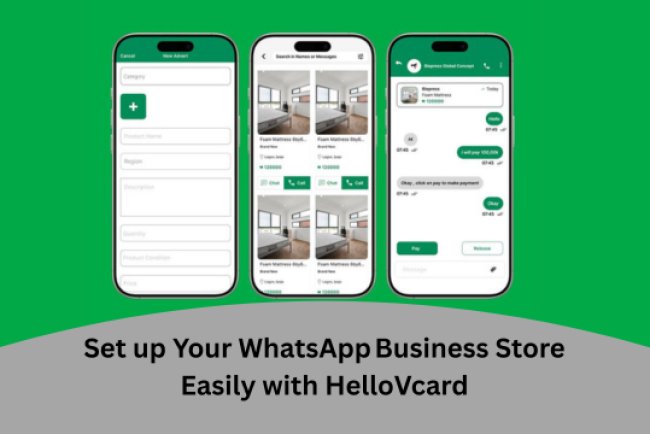
For product-based businesses and service providers with defined packages, HelloVcard's WhatsApp Store integration converts the card itself into a transaction point. Contacts who scan your QR code see your card profile and your product or service catalogue on the same page. They tap Order, a pre-filled WhatsApp message opens, and the conversation starts with the product already specified.
246 payment transactions have been processed through HelloVcard accounts — demonstrating that the card-to-order flow works in practice. For small business owners, adding a WhatsApp Store to their HelloVcard turns every card share into a potential sales conversation without any manual follow-up required.
Business Opportunity Checklist — Is Your HelloVcard Working Hard Enough?
- Booking CTA as primary button (not just "Contact Me")
- Interaction dashboard checked after every networking event
- Card built around highest-value offer, not just contact details
- Card URL in email signature, LinkedIn, WhatsApp bio
- One social proof element: client logo, metric, or testimonial
- Intro video added (45-60 seconds, phone recording)
- WhatsApp Store added if product or packaged service business
- Card reshared proactively at least once per week via WhatsApp Status
How to Turn Your HelloVcard Into a Lead Generation Asset
Step 1: Audit Your Current Card
Log in at hellovcard.com/login and review your card against the checklist above. Identify the one element most likely to be losing business — usually the CTA or the absence of social proof — and fix that first.
Step 2: Add a Booking Link as Your Primary CTA
Connect Calendly, Google Calendar booking, or any scheduling tool and set the booking link as your primary CTA button. Label it specifically: "Book a 30-minute strategy call" rather than "Contact me." Specificity increases tap rate.
Step 3: Add One Social Proof Element
Choose your strongest social proof: a recognisable client logo, a specific result you have delivered, or a short client testimonial. Add it to your card profile. One element, prominent placement, directly relevant to your target prospect.
Step 4: Activate Proactive Distribution
Add your card URL to your email signature today. Update your LinkedIn Featured section. Set your WhatsApp bio. Pin your card to WhatsApp Status. Each integration takes under five minutes and generates passive card distribution from that point forward.
Frequently Asked Questions
How many card views does it take to generate a business enquiry?
This depends heavily on your niche, your CTA, and how qualified your card viewers are. From HelloVcard's platform data, cards with a specific booking CTA, a completed profile, and at least one social proof element convert at significantly higher rates than incomplete cards. There is no universal number — but every improvement to your card configuration improves the conversion rate at every volume level.
Should I use HelloVcard for cold outreach or only warm networking?
Both — but the approach differs. For warm networking (people you have met), share your card as a follow-up tool and use interaction data to prioritise who to call. For cold outreach, share your card URL with a specific, relevant reason for reaching out rather than as a generic introduction. A card shared with context converts better than one shared without it.
Can I see which companies or individuals are viewing my HelloVcard?
HelloVcard tracks aggregate interaction data — opens, taps, saves by date and time — rather than individual viewer identities. This gives you volume and timing data without compromising viewer privacy. For source-level attribution, add UTM parameters to your card URL for different distribution channels and track them separately.
Is HelloVcard suitable for B2B lead generation as well as B2C?
Yes. The platform is used across both contexts. B2B users typically configure their card with a booking CTA, case study link, and LinkedIn integration — prioritising professional credibility signals. B2C users typically use WhatsApp direct messaging CTA and WhatsApp Store integration — prioritising immediate conversation and transaction. The same card can carry both if your business serves both markets.
Your card should be generating business, not just storing contact details. Audit your HelloVcard today at hellovcard.com/login or create one free at hellovcard.com/register — and start treating it as the lead generation asset it can be.
Build your free digital business card at hellovcard.com/create and review plan options on the HelloVcard pricing page — professional features from ₹99/month.
The Difference Between a Contact Card and a Lead Generation Asset
A contact card answers one question: how do I reach this person? A lead generation asset answers three: who is this person, why should I work with them, and what do I do next? Most digital business cards stop at question one. A configured HelloVcard answers all three — with your designation establishing credibility, your intro video establishing trust, and your CTA providing the specific next action.
The difference between a card that generates enquiries and one that doesn't is almost always the CTA. A CTA that reads "Contact" or "Email me" gives the contact a method but no reason. A CTA that reads "Book a free 20-minute audit" or "See our client results" gives them both a reason and a specific action — the two elements that convert passive card views into active conversations.
How Interaction Data Identifies Your Warmest Prospects
Across 11,380 tracked card interactions on HelloVcard, the behavioural pattern for warm prospects is consistent: multiple card views within a short window, followed by a CTA tap. A contact who views your card once and moves on is browsing. A contact who views your card three times in two days and taps your booking link is ready for a conversation.
HelloVcard's analytics give you this data in real time. The professional move is to check your card views after any active distribution event — an event, a broadcast message, a WhatsApp Status post — and prioritise follow-up with contacts who engaged most recently and most deeply. This is warm outreach with data, not cold outreach with guesswork.
Business Opportunity Tactics by Professional Sector
| Sector | Best CTA for lead generation | Social proof element to add | Primary distribution channel |
|---|---|---|---|
| Consulting / advisory | Book a free discovery call | Client outcome in tagline | LinkedIn Featured + email signature |
| Real estate | View current listings | Transaction volume or area specialisation | QR at property sites + WhatsApp |
| Recruitment | Submit a brief or view placements | 45-second video — conversion doubled | LinkedIn + email to hiring managers |
| Financial services | Book a portfolio review | Regulated credentials in designation | NFC card at client meetings |
| Freelance creative | View portfolio | Named client or campaign result | Instagram bio + email signature |
How long does it typically take for a configured HelloVcard to generate its first inbound enquiry?
Users who complete all five integrations — email signature, LinkedIn, WhatsApp About, QR on materials, social bios — and set a specific booking CTA typically report first inbound enquiries within 2-4 weeks. The timeline depends on how actively the card is being distributed. Passive integrations alone generate enquiries more slowly than passive integrations combined with active sharing at events or in follow-up messages.
Should I use HelloVcard for cold outreach or only for warm networking?
Both, but with different expectations. In warm networking, your HelloVcard link in a follow-up message has a high conversion rate because context and rapport already exist. In cold outreach, the card link adds credibility to an introduction email or LinkedIn message — the contact can verify who you are and what you do before deciding whether to respond. It doesn't replace the outreach; it strengthens it.
What's Your Reaction?